
Work methodology
Farms enrolled in Nossa Voz
Upon joining Nossa Voz, a cooperative, trader, or agribusiness company identifies the farms within its supply chain that are interested in adopting the Nossa Voz helpline.
On-farm training on the use of Nossa Voz
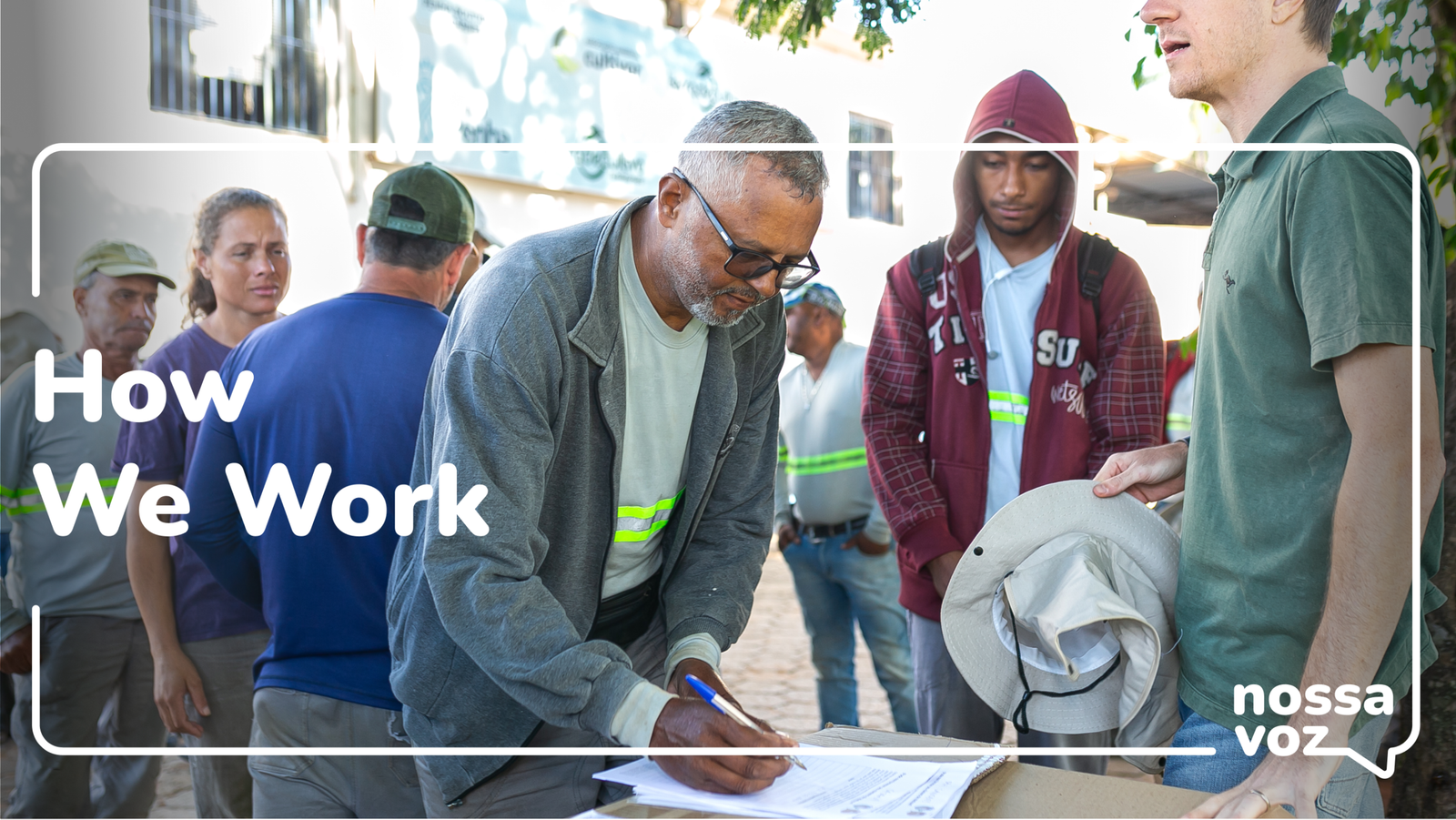
Once a farm joins, we conduct on-site training for its workers to inform them about how to use the helpline, as well as to guide each farm’s focal points on their role.
Communication and awareness campaign on rights and duties
After participating in the training, workers begin receiving a communication campaign on rights and duties. This campaign is delivered via WhatsApp through cards, audio messages, videos, and short illustrative texts.
Receiving interactions
Once aware of their rights, workers begin interacting with Nossa Voz free of charge and with guaranteed confidentiality.
Information collection and dialogue with producers
These interactions are compiled into a report that is sent to farms and companies using Nossa Voz, facilitating the identification, monitoring, and assessment of risks within their supply chains.
Complaint resolution
If any irregularities are identified, we propose a corrective action plan. Through social dialogue among all parties involved, we work toward resolving the complaint.
Nossa Voz Case Management System (CMS)
The management and classification of worker interactions are carried out through the Case Management System (CMS), which serves as a central governance and risk monitoring tool. Most cases are resolved through mediation and social dialogue, conducted by Nossa Voz together with the worker and the focal point of the farm or company, ensuring prompt responses and collaborative solutions.
The involvement of traders, cooperatives, or companies occurs only when necessary or in cases involving multiple complaints, preserving both efficiency and confidentiality in the process.
All CMS operations follow a transparent Action Protocol developed by LRQA based on its Global Protocol. This protocol, aligned with national laws and international due diligence regulations, ensures consistency, traceability, and compliance at every stage of case management, strengthening partner trust and the effectiveness of the initiative.
Preventive Strategy
The Instituto Trabalho Decente (ITD) has developed a set of systematic actions to strengthen and disseminate Nossa Voz, a dual prevention and outreach strategy in municipalities that contributes to reducing the incidence of forced labor in coffee sector production activities.
This involves a series of ongoing training initiatives and technical advisory services for municipal managers, public officials, and workers in their cities of origin, who historically migrate in search of temporary work during coffee harvests. In addition, activities are carried out to coordinate and support the strengthening of public policies to combat forced labor and human trafficking with the state governments of Bahia and Minas Gerais.
The project was developed in four municipalities in the Irecê region: Bonito, Canarana, Lapão, and São Gabriel. These locations were selected because they are municipalities in Bahia where workers often migrate under vulnerable conditions and are exposed to the risk of human trafficking for forced labor in coffee harvesting in Minas Gerais.
The work focuses on five main areas:
1. Training cycles, conducted on an ongoing basis with:
- Municipal public policy managers (mayors and secretaries);
- Municipal staff (technical personnel from various public policy departments);
- Rural workers who migrate for coffee harvesting in Minas Gerais.
2. Technical advisory, a set of continuous actions involving monitoring, follow-up, and advisory support, including:
- Situational mapping of the forced labor issue in the four municipalities
- Development of actions to prevent and combat human trafficking and forced labor, as well as strategies for sustainable local development
- Support in building an Action Plan for the Promotion of Decent Work and Sustainable Local Development
3. Strengthening prevention and response networks for forced labor and human trafficking through:
- Participation and contribution in advocacy spaces;
- Coordination of workshops for exchanging best practices;
- Promotion of workshops and seminars;
- Signing of the “Regional Pact for the Promotion of Decent Work: a commitment by society to combat forced labor in the Irecê region” by 23 organizations.
4. Technical support actions by the Universidade do Estado da Bahia, such as:
- Conducting research with workers who migrate for coffee harvesting;
- Mediation in the implementation of the Human Trafficking and Forced Labor Clinic in the Irecê region in partnership with the Universidade do Estado da Bahia;
- Presentation of supported Forced Labor and Human Trafficking Clinics.
5. Production of materials and campaigns:
- Maps, studies, reports, and educational materials useful for disseminating the mechanism among workers.